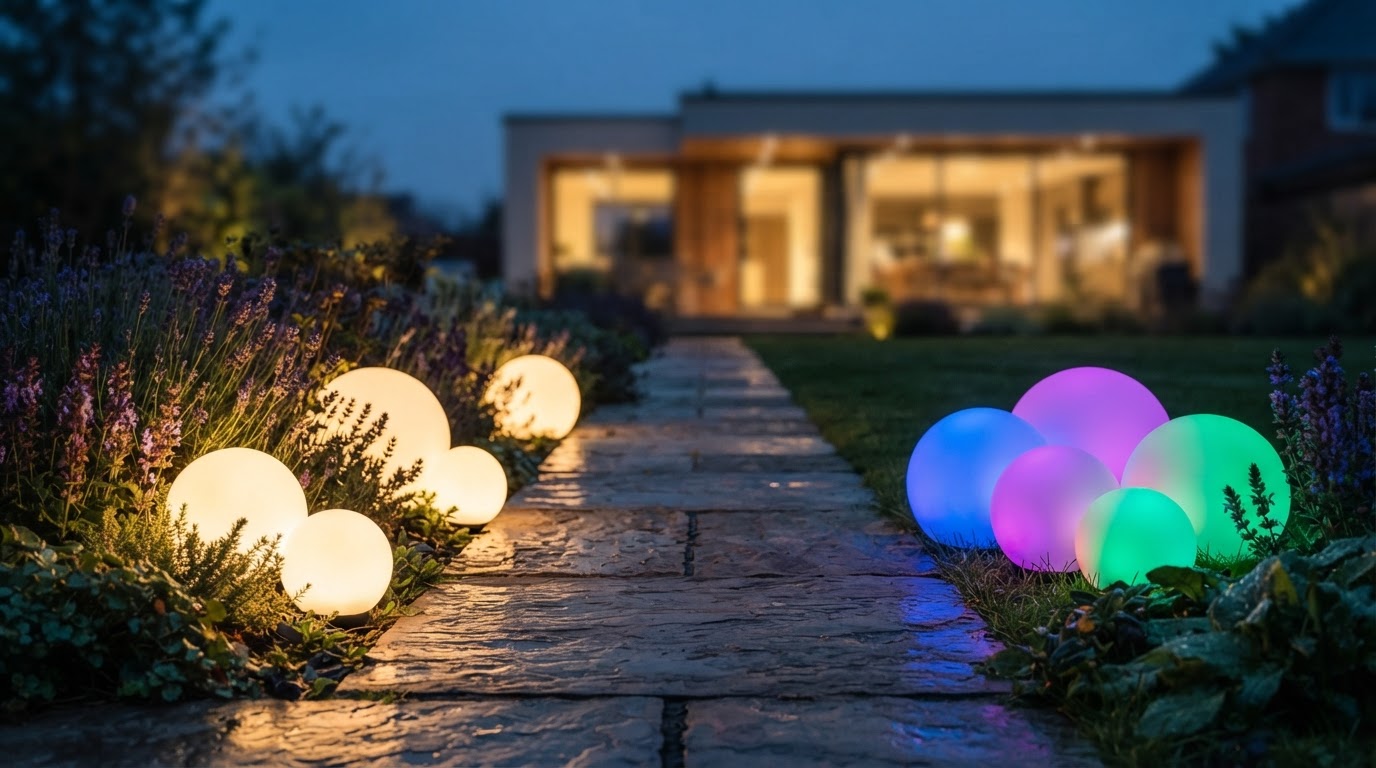
Solar Globe Light Color Dynamics and RGB Efficiency
 Maya ChenContributing Editor
October 25, 2026 — The shift toward multi-mode RGB landscapes has accelerated, placing the Solar Globe Light at the center of a debate regarding decorative utility versus lumen maintenance. While the market pushes for high-saturation color cycles, the technical reality often involves a significant trade-off in battery longevity compared to static warm-white counterparts.
The conventional wisdom says that more colors equate to higher value, yet this ignores the voltage drop inherent in cycling through the visible spectrum. According to Nature's Solar Lights, standard color-changing stake lights utilize a 7-color rotation, often housed in crackled glass to mask the lower light density of colored diodes. This aesthetic choice frequently compensates for the fact that a dedicated red or blue LED generates fewer usable lumens for pathway safety than a dedicated 3000K white chip. When scaling yard landscapes with solar globe light orbs, the integration of these colors must be handled with more precision than simple plug-and-play installation suggests.
The RGB Performance Audit
Here's the part nobody talks about: the power consumption of an RGB controller in a solar-powered circuit adds a constant parasitic drain that static lights avoid. In a standard Solar Globe Light, the transition between hues requires a pulse-width modulation (PWM) controller to blend the red, green, and blue diodes. Run the math: a typical 600mAh Ni-MH battery powering a single white LED can maintain 8 hours of runtime, but that same cell driving a three-diode RGB cycle often sees a 20% reduction in duration due to the controller's overhead and the higher forward voltage required for blue and green wavelengths. When considering solar globe light performance for outdoor moon lamps, the white-light mode almost always outperforms the color-cycling mode in terms of raw visibility and duration. Furthermore, the placement of these units is critical to ensuring the internal photovoltaic panel receives enough direct UV to offset this increased demand. If you are learning how to place a solar globe light for garden use, you must prioritize southern exposure even more strictly for color-changing models than for standard ones. The visual appeal of large solar glass orb garden decor is undeniable, but unless the internal solar array is sized to handle the 3.2V to 3.4V requirements of green and blue LEDs, the "color change" will inevitably fade to a dull red as the battery voltage drops below the threshold of the other diodes.
Expert tip: To maximize the lifespan of a color-changing Solar Globe Light, manually select a single static color during winter months. This reduces the workload on the internal controller and prevents the rapid battery cycling that occurs when the unit struggles to maintain the higher voltage required for a full RGB rotation.
I’ll change my mind when manufacturers start standardizing larger lithium-phosphate (LiFePO4) batteries in small-format globes to handle the specific discharge curves of multi-diode arrays. Until then, consumers should view color-changing modes as a secondary feature rather than a primary light source.