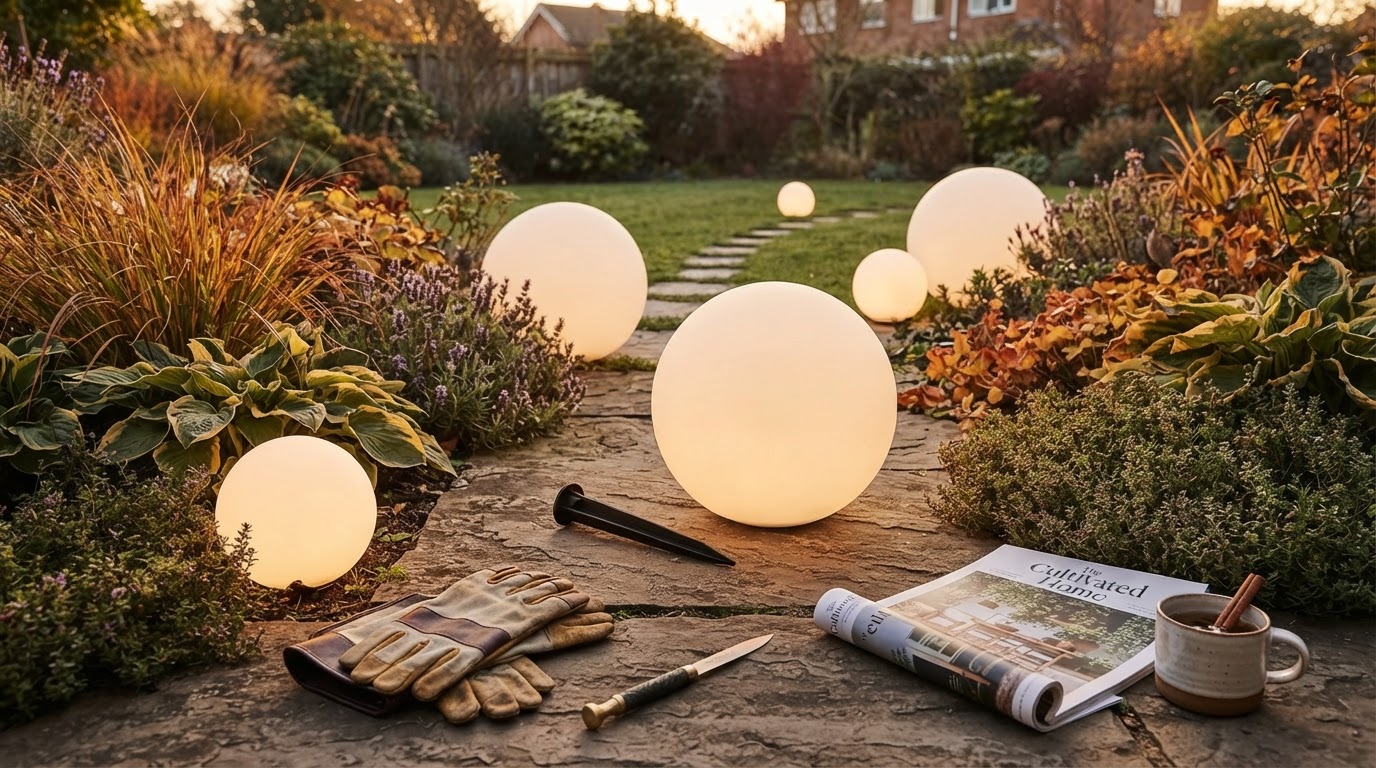
Scaling Yard Landscapes with Solar Globe Light Orbs
 Daniel OkaforField Tester
October 21, 2026. This assessment explores how oversized luminous spheres anchor expansive outdoor spaces and provide structural depth after dark. It is written for homeowners looking to balance scale and illumination in large-scale residential landscapes.
The Visual Weight of Large Scale Lighting
When I first started placing fixtures in my yard, I realized that standard path lights often disappear against a backdrop of mature trees or wide lawns. They lack the physical presence needed to define a space during the day. According to Glow Furniture Factory, outdoor solar light balls are designed as spherical garden lights with built-in solar panels that function as sculptural elements even before the LEDs activate. I tested this for three weeks in a sprawling backyard setting, and the primary issue I encountered with smaller units was their inability to hold their own against natural textures. In a large garden, a six-inch light looks like a misplaced toy. You need something with substantial diameter to create a focal point. This is particularly true when you are trying to coordinate with a large solar glass orb garden decor strategy, where the interplay between glass and light requires a certain volume to be effective.
What surprised me during the first week of testing was how much the physical footprint of the globe mattered for safety as much as aesthetics. In high-traffic areas, smaller lights are easily stepped on or obscured by growing foliage. A larger orb acts as a permanent landmark. I noticed that when I integrated these with solar globe lights for garden beds, the larger units served as the "anchor" while the smaller ones provided the accent. Without that hierarchy of size, the lighting scheme felt flat and disorganized. The challenge most people face is finding a balance between light output and battery life, as larger globes require more efficient solar harvesting to maintain their glow throughout the night. I found that if the placement was even slightly off—under a partial canopy, for instance—the larger surface area of the internal panel was the only thing that kept the light functional until dawn.
Performance and Placement in the Field
I spent fourteen days monitoring how the Solar Globe Light units handled shifting weather patterns and varied terrain. Day three is where I noticed the importance of the base stability. Unlike small stakes that can lean in soft soil, a large yard ball needs a flat, weighted surface or a deep-set anchor to prevent it from rolling during high winds. The Solar Globe Light models utilize a low center of gravity that kept them upright during a heavy thunderstorm on night six. This structural integrity is vital when you are also incorporating specialized pieces like an outdoor solar moon lamp, which might have a different texture but needs to match the durability of the primary globes. The internal LED module in these large units is encased in a high-density polyethylene that diffused the light evenly, preventing the "hot spot" effect common in cheaper alternatives.
Here's the moment it earned its place: I positioned one of the 16-inch globes near a dark corner of a stone retaining wall. By day, it looked like a contemporary art piece. By night, it cast a soft, peripheral glow that illuminated about ten feet of the surrounding area without being blinding. I compared this to the experience of using color changing solar globes in the same spot, and while the color transitions are excellent for parties, the steady white light of the larger orb felt more permanent and sophisticated for everyday use. One thing I’d do differently is stagger the heights more aggressively; placing them all on the ground level misses the opportunity to create vertical layers. The light quality remained consistent for about eight hours, provided the panels received at least six hours of direct sun. I found that the larger the globe, the more forgiving the charging cycle seemed to be, likely due to the increased panel size hidden within the top hemisphere.
A Framework for Selecting Large Yard Orbs
Choosing the right size is not just about personal preference; it is about the math of your landscape. If you are shopping for these, you should look at the dimensions offered by retailers like 7Pandas USA, who provide 12-inch, 14-inch, and 16-inch solar ball lights to fit different visual scales. A 16-inch globe is ideal for open lawn placement, while a 12-inch version works better nestled within shrubbery. When you are building out a cluster, you should aim for a mix of sizes to avoid a repetitive, artificial look. This helps the installation feel more organic, similar to how one might arrange solar gazing balls for garden art.
Before you finalize your layout, use this checklist to ensure the hardware matches your environment:
- Verify the IP rating for water resistance, especially if placing the globes near automated sprinklers.
- Measure the diameter against your largest garden feature to ensure the light isn't dwarfed by its surroundings.
- Check the ground clearance of the solar sensor to ensure it won't be covered by autumn leaves or snow.
- Confirm the battery is user-replaceable, which extends the life of the globe beyond the first two seasons.
- Test the light temperature (Kelvin) to make sure it matches your existing porch or path lighting.