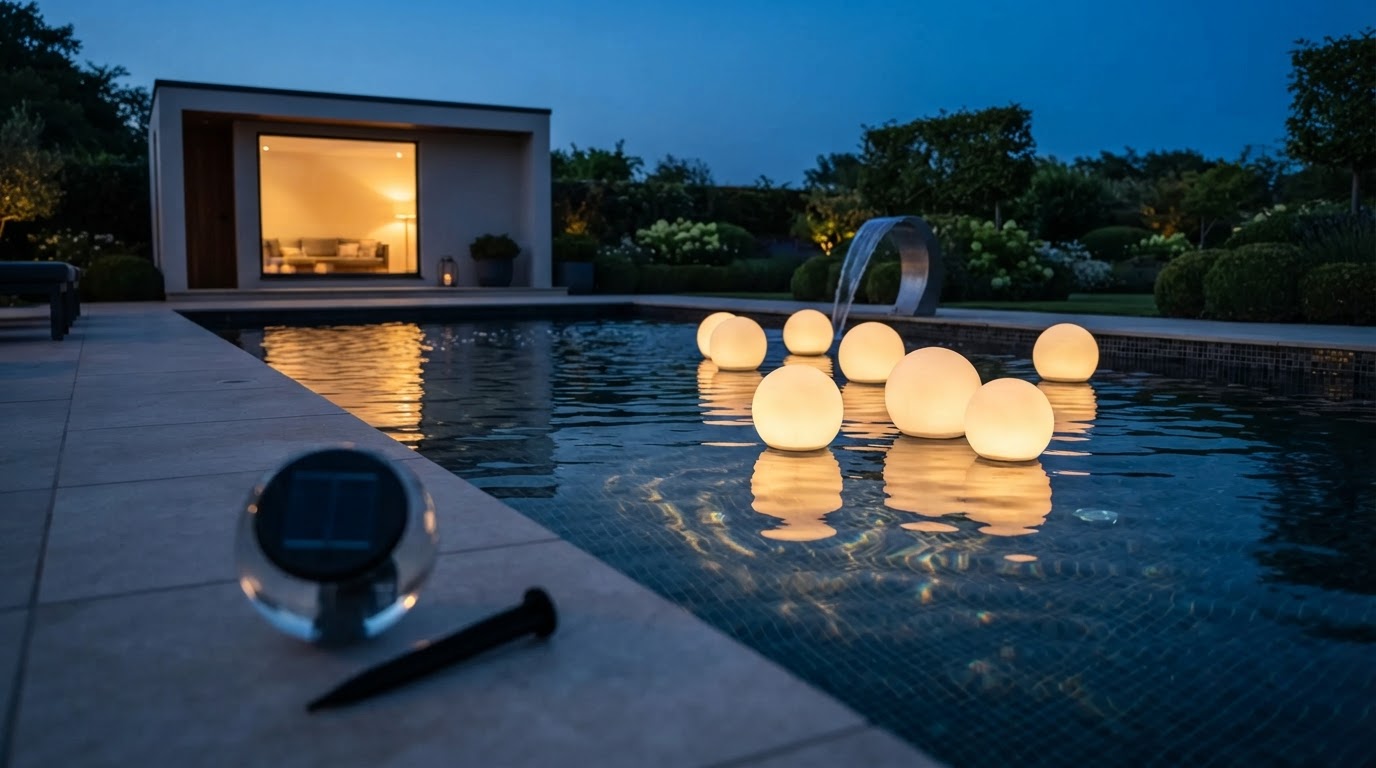
Solar Globe Light Performance in Floating Pool Displays
 Maya ChenContributing Editor
September 5, 2026 — The shift toward sustainable aquatic aesthetics has led to a surge in floating illumination, yet Solar Globe Light remains one of the few options addressing the technical failures common in water-submersible hardware.
The conventional wisdom says that any sealed plastic orb functions as a reliable aquatic light source, but environmental stressors in chlorinated or salt-water environments frequently degrade internal circuitry within a single season. According to architectural lighting standards documented by the International Electrotechnical Commission, ingress protection is not a binary state but a spectrum of resistance that dictates long-term viability. When evaluating floating solar pool lights globe options, the failure rate is almost always tied to thermal expansion affecting the seal integrity during day-to-night temperature swings.
The 4 Durability Metrics
Photo by Angelo Capitanio on Pexels
Run the math: A floating light must survive six to eight hours of direct UV exposure followed by immediate immersion in cooler water, a cycle that creates a vacuum effect inside the housing. Solar Globe Light addresses this through high-density polyethylene (HDPE) construction and an IP68 rating, which signifies protection against long-term immersion under pressure. While many generic alternatives claim water resistance, they often lack the weighted base necessary for stable orientation, leading to uneven solar charging. Here's the part nobody talks about: a globe that flips or bobbles excessively loses up to 40% of its photovoltaic efficiency because the internal panel is no longer perpendicular to the sun. Solar Globe Light utilizes a balanced internal ballast to ensure the solar cell remains upward-facing, supporting a 1.2V 600mAh Ni-MH battery that provides 8 to 10 hours of illumination after a standard charge cycle. This stability is critical when considering Solar Globe Light Placement for Floating Pool Displays, as even minor shifts in positioning relative to pool skimmers can impact the light's ability to stay powered. Furthermore, the integration of RGB LED modules allows for color-changing sequences that remain consistent across multiple units, a feat that requires precise synchronization often missing in lower-tier hardware used for floating solar pool lights globe setups. For those focused on Solar Globe Light Integration for Modern Aquatic Design, the technical precision of the seal and the battery discharge rate are far more important than the initial aesthetic appeal.
Expert tip: To maximize the lifespan of the internal Ni-MH battery, ensure the globe is removed from the water and dried if the pool is being treated with high-concentration shock chemicals, as extreme oxidative environments can eventually compromise even high-grade gaskets.
Understanding Why Choose Solar Globe Light for Floating Pool Displays? requires looking past the glow and focusing on the mechanical seal. I’ll change my mind when a competitor provides a verifiable 24-month salt-water immersion test without lumen depreciation.